Long before the Greeks wrote down their philosophies, Zoroaster taught that the entire universe is locked within a vast, three-part cosmic cycle: a pristine beginning, a chaotic separation into light and darkness, and a violent, purifying transformation that ushers in a higher, eternal reality. This is precisely the pattern encoded in the Emerald Tablet.
For millennia, this knowledge was fiercely guarded by secret societies—cloaked in symbols and allegories—because they believed humanity was not ready to wield such power. But in 2011, something intriguing happened. An anonymous text titled The Book of Aquarius entered the public domain, making a radical and groundbreaking claim. The cryptic symbols, monstrous beasts, and mythological gods were never magical incantations; they were merely a security code—designed to prevent greedy kings and tyrants from discovering the truth. The actual process is simple and natural, utilizing a raw material accessible to every human being on Earth.
Do you recall the interesting discovery we made in the second part? The Emerald Tablet spoke of a pristine liquid—one that many commentators identified as a form of water. Here, The Book of Aquarius asserts that the true substance—the prima materia or raw material for the Philosopher's Stone—is nothing other than our own distilled "water of life": human urine. To the modern mind, this seems absurd, if not outright repulsive. Yet, to an alchemist, it makes perfect sense. This is a biological fluid that has coursed through the living furnace of human veins, becoming infused with concentrated life force and the body's microscopic minerals.
To transform this ordinary, everyday fluid into the legendary Philosopher's Stone, one need only carefully follow the instructions found on the Emerald Tablet: "Separate the thick from the thin; gently and with great care, separate the earth from the fire. It ascends from earth to heaven and descends again to earth, receiving the power of things both superior and inferior."
According to The Book of Aquarius, this process relies on patience, self-restraint, and natural law as the journey unfolds through three distinct stages. The first stage involves collection and initial distillation, where the raw fluid is collected and carefully distilled to remove crude impurities, leaving behind a clear, concentrated biological essence. The Emerald Tablet begins by stating that the Great Work requires a single, incorruptible root substance from which all things originate. In The Book of Aquarius, this raw biological fluid is presented as the "Universal Water" of the microcosm. Distilling this raw fluid in the first stage is the act of isolating this primordial essence and stripping away the external, crude impurities of the physical world, leaving only the pure, pristine primal substance. "Crude" refers to the heavy, foul-smelling salts and earthy impurities present in the unrefined liquid, while "subtle" refers to the clear, viscous biological water that rises as vapor when heated; this process must be carried out gently and with great ingenuity.
For the Emerald Tablet explicitly warns that the separation must be performed "gently"—that is, with care and great ingenuity. The first stage, as described in The Book of Aquarius, emphasizes that the initial distillation must never be conducted using intense, scorching heat, as excessive heat destroys the subtle biological life force within the liquid.
The second stage is known as the Hermetic sealing. Here, the refined liquid is placed inside a round glass flask—famously known as the "Philosophical Egg"—and then hermetically sealed to prevent the ingress of air. Once sealed, no external element can enter, and nothing from within can escape. This fulfills the Tablet's fundamental requirement that the substance's power remain intact and complete. By sealing the glass, you create a self-contained universe—an artificial womb where "the wind carries the essence in its belly," allowing the liquid to undergo a complete transformation driven by its own internal forces, without the loss of even a single drop of its life force.
The third stage involves gentle heat. The flask is placed over a constant, mild heat source—traditionally a warm water bath. This process simulates the natural body temperature of a brooding bird incubating its eggs. This directly alludes to the explicit warning in the Emerald Tablet to proceed "gently and with great ingenuity." In alchemy, intense fire destroys the subtle life force; the gentle heat of a water bath acts as the "Sun"—the father of the Stone—creating the environment necessary to awaken the matter. Under this low heat, the liquid slowly evaporates and rises toward the top of the glass sphere—ascending to the heavens, in alchemical terms. The temperature is cooler at the top of the sphere; thus, upon reaching the summit, the vapor condenses into droplets and falls back down—descending to the earth. This process takes approximately nine months.
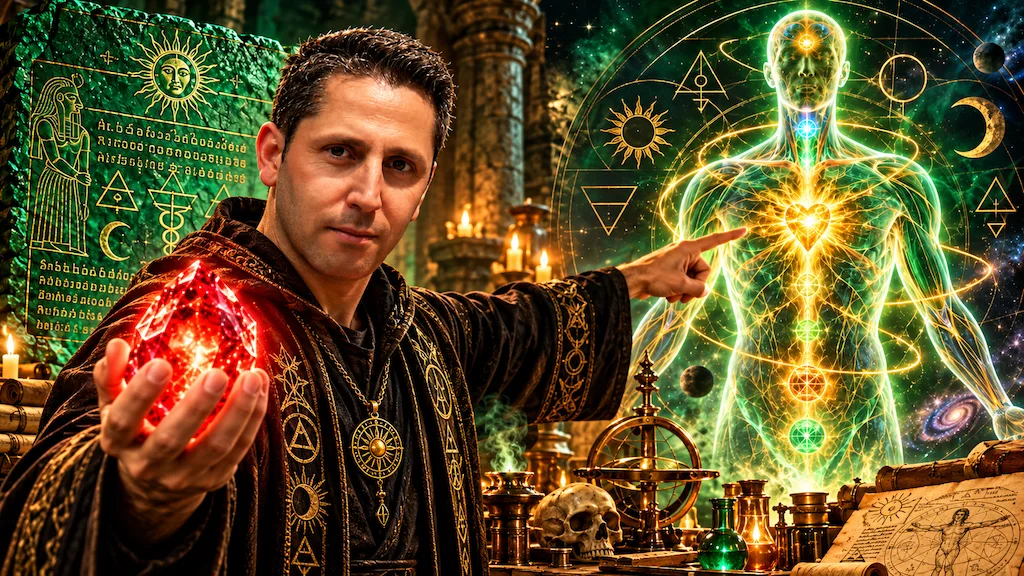
Cycle by cycle, month by month, the liquid moves continuously in a closed loop. Through this repeated evaporation and precipitation, the substance gradually breaks down, separating from the heavy, dark sediment at the base of the flask. As the weeks pass, the remaining moisture dissipates. The substance undergoes distinct color changes famously recorded in alchemical literature: first blackening (Nigredo), then clearing to a brilliant white (Albedo), and finally hardening—transforming into a deeply radiant, ruby-red crystalline substance: the Philosopher's Stone.
Observe the wondrous geometry at play here. This sealed glass vessel is not merely a laboratory instrument; it is a living mirror. From a biological perspective, this vessel functions as an artificial womb: a sealed, fluid-filled chamber maintained at precise body temperature, nurturing new life in complete isolation. From a cosmic perspective, the vessel mirrors the Earth beneath the celestial dome: moisture rises toward the heavens, condenses, and falls back as rain to fertilize the soil below. This serves as the ultimate testament to the supreme law of the Emerald Tablet: "As above, so below; and as within, so without." The very pattern governing human birth and Earth’s climate is here—encased within the glass—to bring forth the Philosopher’s Stone.
Clavis Artis (The Key to the Art) is a renowned alchemical manuscript discovered in Germany in the late 17th century. Written in German Gothic script and adorned with watercolor illustrations, the manuscript claims to be a translation of an ancient text by Zoroaster, presenting the ancient Persian prophet as the ultimate, foundational alchemist. The anonymous author employs this attribution to frame the entire work as a secret system of physical and spiritual occult sciences—a system that bridges cosmic duality with practical laboratory work. Take a close look at this image, taken from the book Clavis Artis. A sealed glass flask rests gently in a water bath. At its base lies a clear liquid containing two crowned figures—a king and a queen—holding hands. Their tails are intertwined; they merge into one and then rise upward.
Here, the seventh Hermetic principle comes into play: the principle stating that gender exists in everything; that everything possesses its own masculine and feminine aspects; and that gender manifests on all levels. For nature relies on the harmonious union of two complementary opposites. Masculine energy is described as assertively penetrating, actively directing its inherent energy toward its counterpart—feminine energy. It is associated with qualities such as conquest, progress, and willpower. Feminine energy, on the other hand, is described as receptive, sacred, and nurturing. The feminine aspect performs the work of generating new thoughts, concepts, ideas, and imaginative forms based on the impressions received from the masculine. The interdependence of these energies is essential. Without the feminine, the masculine lacks order or purpose, leading to chaos and unbridled action. Without the masculine, the feminine remains in a state of perpetual reflection without taking action, leading to stagnation and restlessness. It is through the harmonious interaction of both energies that thoughtful action and willpower combine with creative force to bring ideas and visions into manifestation. In historical alchemical texts, the masculine principle is associated with solar, active, and sulfurous qualities, while the feminine principle is linked to lunar, passive, and mercurial attributes. To create a primal substance, historical recipes specifically called for the collection and combination of the natural essences of a man and a woman in equal proportions before sealing the vessel. The rationale was that this process harmonized the "opposing poles" of human biology within the container.
However, there is a crucial point: these two individuals represent the union of fluids—not merely of a man and a woman, but of true soulmates. This is because the heart chakra serves as the central bridge between the lower physical and higher spiritual chakras. When two people establish a deep, resonant bond—what is known as a soulmate connection—this center acts as a crucible where individual ego boundaries soften, allowing a unified energy field to emerge. This energy field triggers a profound chemical transformation in both bodies—a transformation that makes the creation of the Philosopher's Stone possible. Modern neuroscience and endocrinology corroborate this ancient belief. These sciences demonstrate that intense love and deep emotional resonance induce rapid neurochemical changes, releasing oxytocin, dopamine, vasopressin, and serotonin while simultaneously dampening stress responses. Indeed, deep love literally alters the chemical composition and physiological state of the human body.
And finally, a golden pinecone rises upward within the neck of the bottle—the universal symbol of activated consciousness and spiritual rebirth. This is the map of the Emerald Tablet presented visually: matter emerges from the male and female principles. They become one. It ascends, then descends. Then follows a process of purification and descent until the red crystal is born. You might now feel that this discovery—being a physical, laboratory-based process—contradicts the idea of unlocking human consciousness. Yet, look closely at the top of the bottle. There, a golden pinecone blooms outward—a universal symbol of awakened consciousness and spiritual rebirth.
If you recall what we discussed in the third part, I proposed that the Emerald Tablet was never merely about an ancient artifact or a material object; rather, it serves as a fundamental key to unlocking human consciousness—a three-stage cycle of "separation," "transformation," and "ultimate union," encoded within the name "Hermes Trismegistus." To the ancient alchemist, the material and spiritual worlds were never separate; "as above, so below." Creating that crystalline red "Stone" within a glass vessel does not stand in opposition to inner transformation; instead, it is a direct, physical reflection of it—the outer vessel acts as a mirror for the inner spirit. The physical distillation of matter is, in fact, the tangible embodiment of that same three-stage cosmic law that flows deep within human consciousness. That Stone encompasses both aspects: a material reality born of nature’s laws and a transcendent symbol of an awakened mind.
Ultimately, the ancient masters did not hide the Philosopher's Stone atop an inaccessible mountain or within a lost tomb. They hid it in a place where a greedy tyrant would never think to look: within human nature itself. The absolute power to transmute matter, balance light and darkness, and elevate human consciousness was never out of reach. This power had been woven into our blood, our souls, and our very being from the very beginning. The code was always yours; you simply had to remember how to read it.