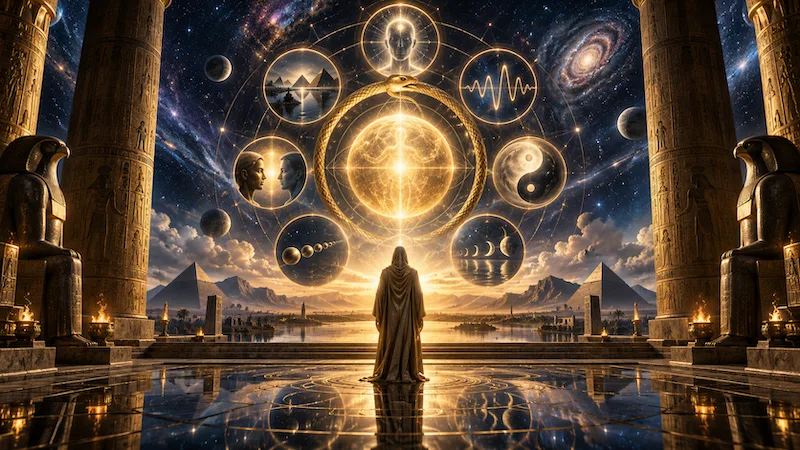
There exists an ancient tradition known as Hermeticism, which has been carefully guarded for centuries. Its aim is to harmonize the diverse esoteric knowledge acquired by seekers—providing a master key to unlock the inner doors of the Temple of Mysteries. The origins of Hermetic teachings trace back to the time of Hermes Trismegistus. These teachings have influenced religions and philosophies across the globe, serving as a unifying force.
Hermeticists adhere to a policy of secrecy, reserving profound truths for those prepared to comprehend them. Throughout history, Hermetic teachings have been preserved by dedicated initiates who transmit this wisdom orally—from lip to ear. Originating in ancient Egypt, Hermetic philosophy has influenced various cultures, yet it remains unaffiliated with any specific religious sect.
The teachings of Hermes Trismegistus encompass the principles and tenets of Hermetic alchemy, which focus primarily on mental forces rather than material elements. There are seven principles of truth; he who grasps them holds the magic key that causes all the doors of the Temple to fly open at his touch.
Principle of mentalism
All is Mind; the universe is mental.
The Principle of Mentalism holds that everything in the universe has its fundamental roots in the realm of mind. It posits that the totality of existence is synonymous with the concept of mind or consciousness. According to this principle, the universe and all its manifestations arise from the workings of the Cosmic Mind. Everything that exists—whether tangible or intangible—is a product of the Universal Mind. Beyond physical matter and observable phenomena, there exists a vast cosmic consciousness that acts as the source of creation and the driving force behind all aspects of existence. The universe operates according to mental laws in which thoughts and consciousness significantly influence and shape reality. The mind plays a pivotal role in the creation and functioning of the cosmos.
Principle of correspondence
As above, so below; as below, so above.
The Principle of Correspondence, expressed by the phrase “as above, so below,” signifies a profound connection between different levels of existence. This principle states that there are inherent similarities and harmonious relationships between various levels of reality. “Above” refers to the spiritual dimensions of higher realms or the macrocosm, while “below” relates to the lower realms—the physical world or the microcosm. This principle implies that what occurs on one level is reflected on another, and vice versa; in other words, the macrocosm and the microcosm are interconnected and interdependent. Patterns, laws, and phenomena governing higher or broader levels of existence also apply to lower or more limited levels, and vice versa.
This concept can be observed in various fields, such as physics, where the behavior of subatomic particles mirrors the structure of celestial bodies. It is also prevalent in spiritual and philosophical systems, where the idea of “as above, so below” is used to understand the connections between the individual and the inner and outer worlds.
Principle of vibration
Nothing rests; everything moves; everything vibrates.
This principle states that nothing in the universe is truly at rest. Everything is in constant motion, and this motion generates vibration. This idea aligns with modern scientific understanding, where we know that particles are always in motion at the atomic and subatomic levels. On a macroscopic scale, celestial bodies, planets, and even galaxies are in constant motion across the vastness of the cosmos. These vibrations can manifest in various ways—from the movement of particles to the oscillation of waves and the rhythm of energy. Everything, from the tiniest particle to the largest celestial body, is subject to vibration. Understanding the Principle of Vibration can have implications for how we perceive and interact with the world around us. It teaches us that change is inevitable and that everything is in a state of oscillation. Nothing remains static, and this dynamic nature of existence affects every aspect of our lives. Embrace impermanence and recognize that everything—including emotions, thoughts, and self-awareness—is in a state of constant motion and transformation.
Principle of polarity
“Everything in this universe exists in pairs; everything has poles; everything has its opposite. The like and the unlike are the same; opposites are identical in nature but differ in degree; extremes meet; all truths are but half-truths; all paradoxes may be reconciled.”
The proposition that everything is dual implies that every existing thing or concept has a complementary counterpart. This duality can manifest in various forms, such as light and darkness, heat and cold, good and evil, positive and negative, and so on. This pair of opposites is interconnected and forms an inseparable whole. The next part of the statement—“opposites are identical in nature but different in degree”—indicates that seemingly contradictory things share common principles or characteristics. For instance, light and darkness are both aspects of the same phenomenon—electromagnetic radiation—yet they differ in intensity or presence. The phrase “opposites are identical in nature but different in degree” implies that opposing poles are fundamentally the same, differing only in intensity, quality, or the degree of their manifestation. Extremes can meet or transition into one another; a continuum connects them, precluding absolute separation.
“All truths are but half-truths” means that any truth we perceive is merely a fragment of a larger whole. Our understanding of reality is limited and can never encompass the full complexity of existence; thus, what we hold to be true may be incomplete or partial.
Finally, the statement “all paradoxes may be reconciled” tells us that contradictions—or apparent contradictions—can be resolved once we grasp the underlying unity of the opposing poles. From this perspective, conflicts arise from our limited perception, and by transcending dualistic thinking, seemingly contradictory ideas can be harmonized.
Principle of rhythm
“Everything flows, out and in; everything has its tides; all things rise and fall; the pendulum swing manifests in everything; the measure of the swing to the right is the measure of the swing to the left; rhythm compensates.”
Much like a flowing river, energy and life force are constantly in motion and circulation throughout the cosmos. Nothing remains stagnant; everything is in a state of perpetual change. Just as ocean tides rise and fall, various phenomena in the universe—whether emotions, economies, seasons, or celestial movements—experience their own ebbs and flows. From birth to death, from growth to decay, all beings undergo cycles of ascent and decline. This principle asserts that no state is permanent and that the only constant is change itself. A back-and-forth motion is found in all aspects of existence. This pendulum-like effect is evident in various natural processes, such as the swing of a pendulum clock or the cyclical behavior of energy between opposing poles—like night and day, heat and cold, joy and sorrow. The principle explains that the extent of the swing to the right is equal to the extent of the swing to the left; this means that the amplitude of oscillation in one direction is balanced by an equal amplitude in the opposite direction.
For every action, there is an equal and opposite reaction, as described in Newton’s third law of motion. The universe seeks equilibrium whenever an imbalance or excess occurs in a particular aspect. Rhythm naturally adjusts to provide compensation and restore harmony. This can be observed in nature’s self-regulating systems, where fluctuations in one area trigger balancing mechanisms that stabilize the system as a whole.
Principle of cause and effect
“Every cause has its effect; every effect has its cause; everything happens according to law; chance is merely a name for law unrecognized; there are many planes of causation, but nothing escapes the law.”
This principle teaches us that nothing happens by accident, for everything has a cause. Nothing comes from nothing, and everything we see in our world is the result of causes. In Hinduism, this is known as the Law of Karma. Good intentions and good deeds contribute to good karma and lead to a happier rebirth, whereas bad intentions and bad deeds contribute to bad karma and lead to an undesirable rebirth.
Most people go through life moving like pawns on a chessboard rather than playing the game of life themselves. The Principle of Cause and Effect teaches us that we can rise above the realm of being influenced by others and become causes ourselves.
The Principle of Cause and Effect is a tool for reclaiming control over one’s life. By applying the Principle of Cause and Effect alongside the principles of Mentalism and Vibration, individuals can master their own temperaments, qualities, and powers, transforming themselves from pawns in the game of life into those who move the pieces on the board.
Principle of gender
“Gender is in everything; everything has its masculine and feminine principles; gender manifests on all planes.”
Masculine energy is described as decisively penetrating, actively directing its inherent energy toward its counterpart—feminine energy. It is associated with qualities such as conquest, progress, and willpower. Feminine energy, on the other hand, is described as receptive, sacred, and nurturing.
The feminine aspect generates new thoughts, concepts, ideas, and imaginative forms based on the impressions received from the masculine. The interdependence of these energies is essential. Without the feminine, the masculine lacks order or purpose, leading to chaos and unbridled action. Without the masculine, the feminine remains in a state of perpetual reflection without taking action, leading to stagnation and restlessness. It is through the harmonious interaction of both energies that thoughtful action and willpower combine with creative force to bring ideas and insights into manifestation.
In the realm of psychology, Carl Jung believed that the harmonious integration of the anima—representing the feminine aspect within a man’s unconscious—and the animus—representing the masculine aspect within a woman’s unconscious—is crucial for personal growth and psychological balance. This process is known as anima-animus integration or the process of individuation. When individuals recognize and accept these unconscious aspects, they become more aware of their inner worlds. By understanding your inner world, you come to better understand your outer world—as above, so below; as below, so above.
The wise serve the higher but rule the lower. They obey the laws descending from above, yet they govern and command within their own plane and over those below them, acting in accordance with the principle rather than in opposition to it. A wise person engages with the law; by understanding its movements, they harness it rather than becoming its blind slave. It is much like a skilled swimmer maneuvering through the water: instead of being a piece of wood tossed about by the waves, they move wherever they choose.
Compared to the ordinary person, the wise individual is like that skilled swimmer, while the other resembles the piece of wood. Both are subject to the law. One who grasps this is well on the path to mastery.