Ancient traditions have spent thousands of years protecting a single, powerful universal process—a secret so potent that the ancients believed civilization itself would collapse if it fell into the wrong hands. Strangely enough, the key to unlocking this secret lies not in the sun-drenched monuments of Egypt or the philosophical academies of Greece, but in the fire-lit sanctuaries of an ancient Persian priest.
At the end of our previous journey, we arrived at an unexpected conclusion: perhaps the Emerald Tablet never described a literal magical stone or a physical elixir of life, but rather a universal process of transformation. It is a process built on three eternal stages—separation, transformation, and a higher ultimate unity—which alchemists throughout history have called the Great Work. These three stages of wisdom are encoded directly into the name of the legendary Hermes Trismegistus, the "Thrice-Great." We see this pattern echoing everywhere: across the cycles of nature, within the crucibles of alchemy, and deep inside human consciousness. Yet this discovery immediately presents a paradox. Why does one of the most famously Hermetic texts ever written lead us straight to an ancient Persian master?
At first glance, connecting Hermetic philosophy to ancient Persia seems abstract, almost irrelevant. But the connection becomes undeniable the moment we return to the famous opening declaration of the Emerald Tablet:
"This is the truth… without falsehood… certain… and most true."
For centuries, casual readers dismissed this line as nothing more than a poetic preamble. Yet, when viewed through ancient Persian philosophy, it reveals itself as the indispensable first step of the Great Work itself. Most people recognize Zoroaster’s core teachings through the famous ethical triad of: Good Thoughts, Good Words, and Good Deeds. But at the heart of his cosmology lies a much deeper concept known as Asha—the ultimate reality, cosmic order, and absolute truth—standing in eternal opposition to Druj, the realm of falsehood, chaos, and illusion.
When we place Hermes beside Zoroaster, a striking alignment emerges. Hermes begins with truth; Zoroaster begins with truth. Neither initiates the seeker's path with promises of physical gold or immortal life. Instead, both demand the immediate, uncompromising separation of reality from illusion as the mandatory prerequisite for any true transformation.
Where Zoroaster speaks of Good Thoughts, rectifying the mind, Hermes speaks of eliminating lies from perception and self.
Where Zoroaster speaks of Good Speech, stabilizing truth into expression, Hermes speaks of certainty, establishing truth beyond doubt.
where Zoroaster speaks of Good Action, manifesting truth in physical reality, Hermes speaks of that which is "most true," reaching absolute completion.
Their vocabularies differ, but they point to the exact same destination: transformation cannot begin until truth is distinguished from falsehood.
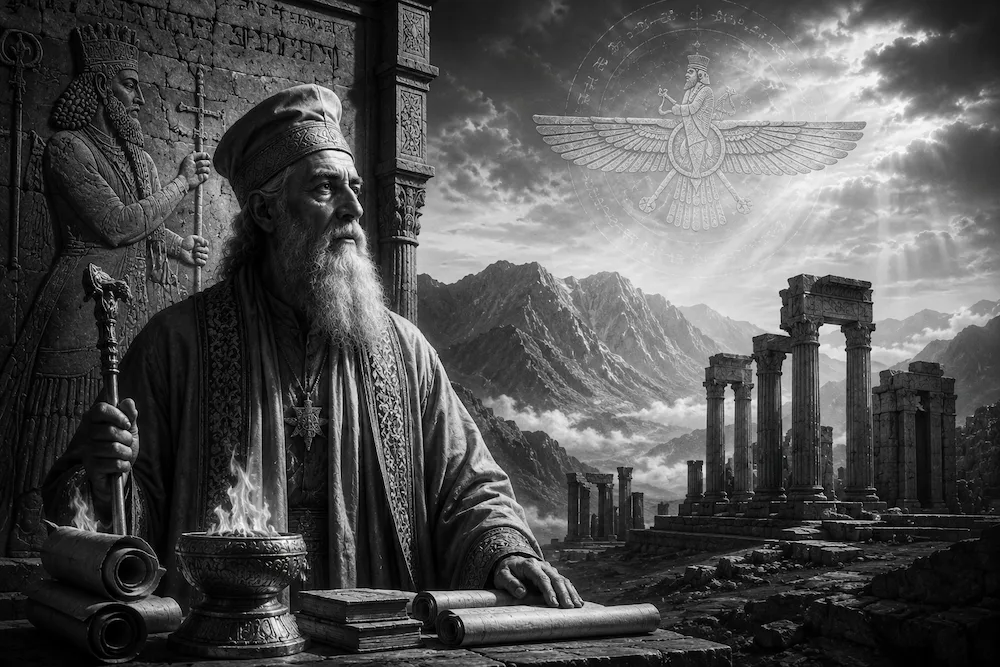
Beyond mainstream history, ancient traditions repeatedly point to Zoroaster not because he ruled an empire or conquered nations, but because he was remembered as the foundational teacher of cosmic laws. While Hermeticism rests upon the three classical pillars of alchemy, astrology, and magic, the ancient world recognized Zoroaster as the undisputed grandfather of these arts.
The legendary Greek thinkers—including Plato, Pythagoras, and Aristotle—openly acknowledged that they learned their deepest secrets from the Magi, the elite class of Persian astrologer-priests descended from Zoroaster. To the Greeks, the word Magia did not mean stage illusions; it signified the advanced, unadulterated study of astronomy, elemental mechanics, and natural law. Even in early Christian gnostic literature, such as the ancient Secret Book of John, readers seeking knowledge of the hidden celestial powers ruling this world are directed straight to the Book of Zoroaster.
In these mystical traditions, the material world is viewed as a dense, imperfect copy of the spiritual realm—a vessel trapping the inner "divine spark." Zoroaster was the first to formalize this cosmic battlefield, dividing reality into two opposing states: the celestial, subtle light above, and the earthly, dense darkness below.
He taught that the physical body remains a dead vessel of earth until illuminated by pure spirit, represented by fire. This is the exact command echoing through the Emerald Tablet: to separate the earth from the fire, the subtle from the gross, with great ingenuity. In Persian cosmology, fire is the living presence of truth—the sole element that cannot be corrupted, purifying everything it touches. When esoteric figures like the Count of Saint-Germain describe ascending through the celestial spheres to encounter Zoroaster, it symbolizes the ultimate mastery of this alchemical fire, purifying consciousness until nothing remains but unadulterated light.
Ultimately, we begin to realize that Thoth, Hermes, and Zoroaster are not merely separate historical figures or mythological deities. They represent a single, continuous archetype of universal wisdom passing through different eras and civilizations, wearing different masks to teach humanity how to separate, purify, and reunite cosmic forces. Zoroaster defined and revealed the dual nature of reality; the alchemist purifies and balances these two opposing poles; and the Christ archetype reveals the final destination where the two become one. As written in the Gospel of Thomas:
When you make the two into one, you enter the kingdom.
And this is like a state echoing the final completion of the Emerald Tablet after the Great Work is finished.
This brings us to a historical reality that cannot be ignored. The oldest surviving physical copy of the Emerald Tablet ever discovered by modern archaeologists is not written in Egyptian hieroglyphics or ancient Greek. It is written in Arabic, preserved inside the foundational 8th-century treatise Kitab Sirr al-Khaliqah—The Book of the Secret of Creation—attributed to the founding father of alchemy, Jabir ibn Hayyan. Behind Jabir's work lies a hidden transmission chain pointing directly back to an enigmatic Persian figure known as Salman al-Farsi.
Given the title Abu al-Katabin, or "Father of the Two Books," early history assumed this merely meant his mastery over religious scriptures. But within the esoteric lineage, it reveals a far deeper truth: it refers to the Lower Book of physical matter (The book of the below)and the Upper Book of spiritual light (The book of the above). How this ancient Persian lineage encoded the Emerald Tablet into Arabic alchemy is the secret we will unlock together in the next article.