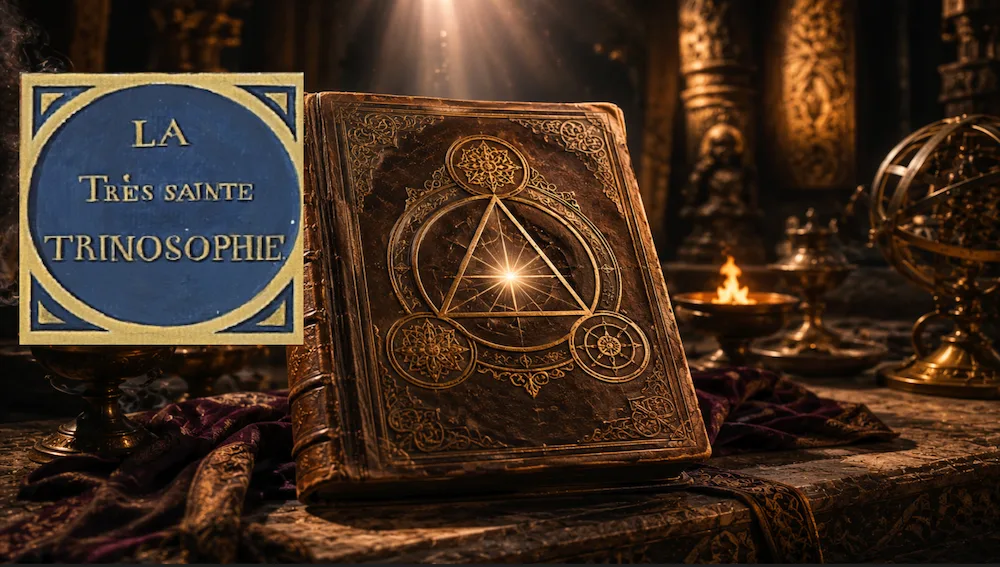
La Très Sainte Trinosophia (The Most Holy Threefold Wisdom) stands as one of the most enigmatic artifacts in the Western esoteric tradition. Preserved as MS 2400 in the Library of Troyes, France, this late 18th-century manuscript—frequently attributed to the Count of Saint Germain or Alessandro Cagliostro—is not a passive text. It is a highly deliberate, visually stunning alchemical blueprint designed to act as a mechanism for spiritual transmutation. To approach The Trinosophia properly is to understand that it operates simultaneously as an initiatic allegory, a philosophical system, and a piece of deliberate pedagogical art.
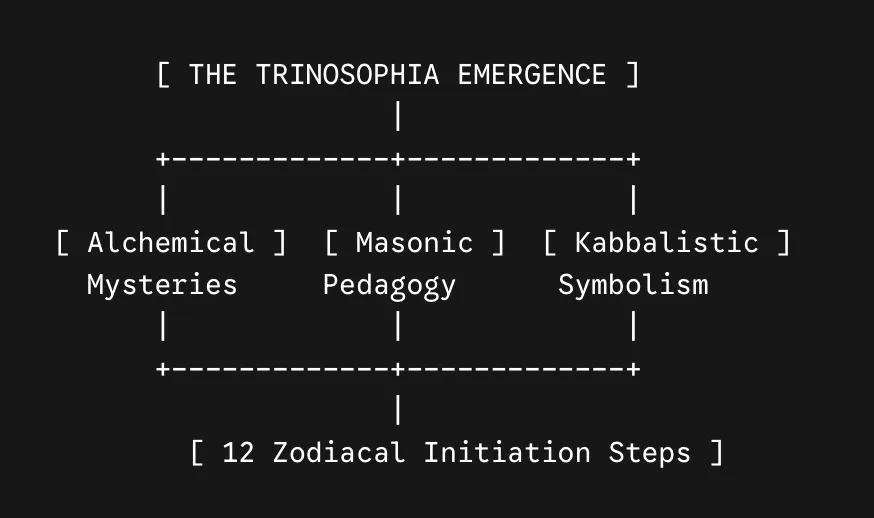
The title itself signals its structural foundation. Trinosophia implies a Threefold Wisdom, a synthesis of the distinct yet inseparable currents that govern reality and human consciousness. The manuscript achieves this through a dense interweaving of text, elaborate alchemical illustrations, and scattered fragments of ancient languages, including Chaldean Hebrew, Ionic Greek, Arabic, and arbitrary ciphers.
Rather than a chaotic pastiche, the work functions as a multi-layered story within a story. The primary narrative unfolds across twelve distinct sections, each corresponding to a sign of the Zodiac. This structure maps a deliberate path of initiation, presenting the soul with a series of elemental trials—earth, air, fire, and water—that must be endured to achieve regeneration.
What makes The Trinosophia a brilliant subject of study is its profound reliance on the human imagination—not as a tool for fantasy, but in the classical sense: a faculty capable of interface with the numinous. The text, written from the perspective of an initiate trapped in the dungeons of the Roman Inquisition, explicitly warns the reader against two primary traps: the misuse of power and indiscretion (the egoic craving to evoke shock and admiration).
To protect these truths from the profane, the author hid forty fragmentary ancient texts directly within the lines of the narrative. The writing regularly reverses, omits vowels, throws letters upside down, or rapidly shifts scripts mid-sentence. Because the code cannot be unraveled by superficial reading, it forces the seeker into a state of active meditation. The interplay between the vivid, hand-colored alchemical plates and the fragmented, coded prose requires the researcher to step outside linear logic. The text acts as a mirror; the process of decoding the exterior manuscript mirrors the interior labor of purifying the self.
An Interdisciplinary Masterpiece
The Trinosophia ultimately demonstrates how separate fields of knowledge—astrology, chemistry, linguistics, and philosophy—can converge into a singular, cohesive creative work. It is an abridged "Book of the Dead" for the living soul, outlining the dissolution of the material form and the crystallization of spiritual immortality. For those dedicated to mapping the hidden frameworks of esoteric philosophy, it remains a brilliant example of how complex, transformative concepts can be successfully encoded into a unified visual and textual experience.