Mystery One: The Caves That Mapped the Stars
Long before temples rose above the ground, followers of the Mehr (religion of Mehr) cult gathered beneath it. Not in palaces, and not in open sanctuaries, but deep underground in chambers carved directly from stone. These spaces, known as Mithraeums, were not ordinary caves. They were sacred chambers accessible only to initiates and those undergoing preparation. No scriptures explained their rites. No rituals were revealed to outsiders. Everything was transmitted through experience. At the heart of every mithraeum stood a single image repeated across the ancient world: Mithra standing above a bull. For centuries, this scene was mistaken for a simple act of sacrifice. In truth, it encoded something far greater. The bull represented the constellation Taurus. The scorpion at its feet represented Scorpio. The snake, the dog, and the raven were celestial symbols, not decorative figures. This was not mythology. It was astronomy. These caves were not merely temples. They were star maps, recording the movement of cosmic ages and the passage of time itself. To enter a Mithraic cave was to descend into the cosmos, to undergo a symbolic death, and to be reborn with knowledge of the heavens. The bull was not an enemy. It represented an age that had ended, a form of life the initiate had outgrown. What was slain was not life, but identity.
Mystery Two: The Bull, the Scorpion, and the Hidden War Within
The bull of Mithraic imagery symbolized the unrefined self: stubborn instinct, attachment to pleasure, and captivity within material life. To “kill” the bull was to master the ego and reclaim spiritual freedom. This act was not violent, but transformative. It marked the first threshold of initiation. Paired with the bull was the scorpion, a symbol of stored energy, transformation, power, and liberation. Where the bull represented spent force, the scorpion represented potential. Even the placement of these figures carried meaning, revealing a struggle between indulgence and mastery. Nearby stood the dog and the snake, opposing forces feeding from the same source, reminders that energy can either enslave or liberate.
All of these symbols pointed toward a greater transition: the shift of cosmic ages. Humanity was moving through Pisces, toward Aquarius, and the inner war mirrored the outer sky.
Mystery Three: Pisces, the Virgin, and the Birth of Consciousness
The age of Pisces, symbolized by the Two Fishes, appears repeatedly in ancient symbolism and religious teaching. It is associated with sacred nourishment: fish, bread, and wine. Pisces represents compassion, sacrifice, and dissolution of boundaries. Opposite Pisces stands the Virgin. The Virgin gives birth to the Savior not biologically, but symbolically. Pure consciousness gives form to divine compassion, allowing the transcendent to be embodied in the world. This is not a story of flesh, but of awareness. Consciousness becomes vessel. Meaning becomes form.
After Pisces comes Aquarius, the age many await. Aquarius symbolizes liberated consciousness, higher wisdom, and clarity freed from instinct. Yet opposite Aquarius stands the lion, symbol of ego, identity, and domination. When these two forces collide without refinement, they form the lion-headed figure known in Gnostic tradition as the Demiurge. The warning is clear: if consciousness rises before instinct is mastered, wisdom becomes control.
Mystery Four: The Burnt City and the First Animation
When people think of animation, they imagine modern studios and digital tools. Yet the world’s earliest known animation dates back nearly 4,800 years, discovered in what is now called the Burnt City. Archaeologists uncovered a simple bowl painted with sequential images of a goat leaping toward a tree. When rotated, the images come alive. Motion captured thousands of years before cinema.
But this was only the beginning. At the same site, archaeologists discovered a 4,800-year-old artificial eye made from bitumen, animal fat, and gold, etched with microscopic lines resembling orbital patterns far ahead of their time. The eye belonged to a woman whose skull structure does not match any known population of the region. The Burnt City itself lay at a crossroads between Mesopotamia, the Iranian Plateau, and the Indus Valley, a convergence point for myths, technologies, and priestly knowledge.
Civilizations forget names, but they remember symbols.
Mystery Five: The Lost Village That Escaped Time
Deep in the mountains of Kerman lies Maimand, a cave village over 12,000 years old. People still live in chambers carved long before recorded history. Its architecture is prehistoric, and its way of life has remained unchanged for millennia. Maimand disappears from historical timelines because it resists classification. Visitors report strange echoes, shadows that move without light, and the unsettling sensation that time itself slows within the caves. Similar experiences are reported in the underground city of Derinkuyu. One lies within a mountain, the other beneath the earth. One teaches how ancient people lived. The other reveals what they feared.
Was Maimand a shelter, or a relic of a forgotten civilization that chose to remain hidden?
Mystery Six: Cyrus the Great and the Architecture of Destiny
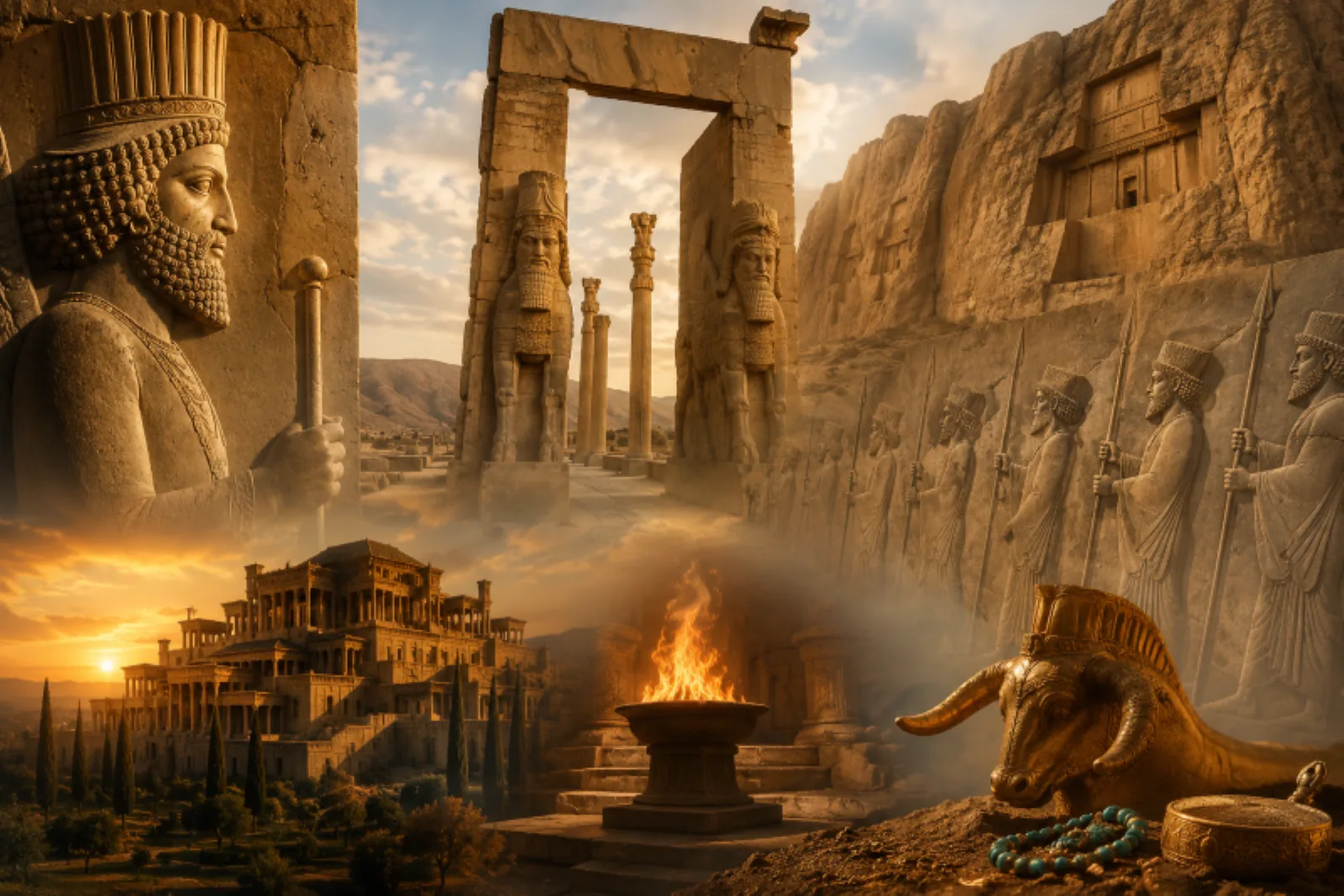
Cyrus the Great conquered Babylon without destroying it, a feat unmatched by many rulers before him. His conquest is recorded on a clay cylinder that speaks not of brutality, but of restoration. Cyrus allowed local religions to remain, rebuilt temples instead of destroying them, and framed conquest as destiny rather than domination. This was not coincidence. Cyrus understood that power must appear moral to endure. The story of the god Marduk choosing Cyrus was not written for the gods, but for the people. Words became weapons. Wisdom replaced fear.
At Pasargadae, the tomb of Cyrus rises in six steps, with the seventh as a final resting place. Some scholars see this as symbolic, mirroring the Mithraic path of seven veils, seven states of being. Not a ladder climbed through ambition, but a shedding of identity until arrival. The tomb becomes a final degree, a gateway to eternity.
What Lies Beneath History
From underground temples and cosmic codes to artificial eyes and whispering deserts, Iran holds secrets that challenge everything we think we know about history, science, and human potential. These mysteries are not isolated anomalies. They are fragments of a forgotten language, one written in stone, symbol, and silence. These are only six secrets. The deeper one looks, the stranger the story becomes. And perhaps that is the final lesson left by those who carved truth beneath the earth: real knowledge does not shout. It waits.