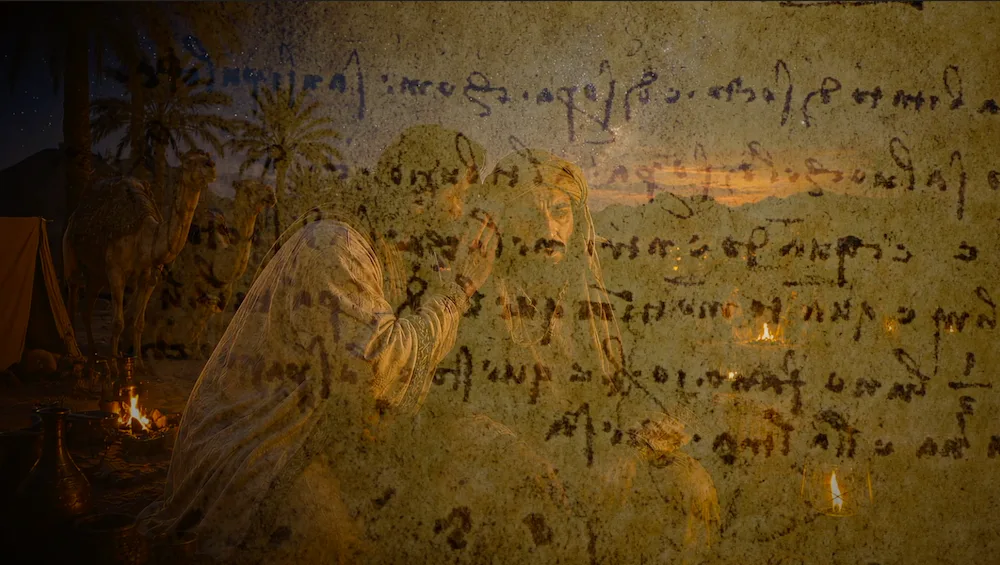
In the eighteenth century, a mysterious man appeared in the glittering courts of Europe. He possessed no kingdom. He held no obvious source of wealth. His origins were uncertain, and even the name by which history remembers him may not have been his real name. Yet he moved comfortably among kings, princes, diplomats, philosophers and aristocrats. He carried extraordinary jewels. He spoke several languages. He displayed an unusual knowledge of history, chemistry, dyes, metallurgy and precious stones. And wherever he appeared, stories followed him.
Europe knew him as the Count of Saint-Germain.
But the deeper we investigate Saint-Germain, the stranger the story becomes. Behind the familiar legends of diamonds, alchemy and longevity lies another possibility—one that leads from Versailles to eighteenth-century secret societies, from the court of Prince Charles of Hesse-Kassel to Johann Caspar Lavater, and ultimately back almost two thousand years to one of the most mysterious figures in the New Testament: the disciple whom Jesus loved.
Saint-Germain and the Secret of the Emerald Tablet
Saint-Germain occupies an important place in our investigation of the Emerald Tablet because the knowledge attributed to him seems to extend beyond ordinary eighteenth-century chemistry. The central idea explored throughout The Mystery of the Emerald Tablet is that the Tablet may not originally have represented merely a physical object. Instead, it may preserve—in symbolic form—a universal principle concerning the transformation of matter and consciousness.
This creates an interesting problem. If the ancient libraries of Persia were destroyed and important bodies of knowledge disappeared with them, how could someone centuries later appear in Europe demonstrating principles that seemed to belong to those older traditions?
Saint-Germain's mysterious reputation becomes particularly interesting when we examine La Très Sainte Trinosophie—The Most Sacred Trinosophia—a work traditionally associated with him. Its imagery leads the reader through fire, initiation, purification, planetary symbolism and ancient religious motifs. Rather than appearing simply as a conventional European chemical manual, it evokes a much older world of initiatory knowledge. Within the hypothesis explored in this series, Saint-Germain therefore becomes more than another man searching for the Emerald Tablet. Perhaps he believed he already understood the principle behind it.
The First Mystery: The Transmutation of Matter
Stories concerning Saint-Germain's ability to manipulate matter circulated throughout the European aristocratic world. One of the most famous concerns King Louis XV of France.
According to accounts surrounding Saint-Germain, the king entrusted him with a flawed diamond. Saint-Germain later returned a stone whose imperfection had apparently disappeared. Whether such stories represent genuine chemical experiments, extraordinary craftsmanship, exaggeration, or later legend is difficult to determine. But they contributed enormously to Saint-Germain's reputation. Even Giacomo Casanova, who was hardly inclined to accept every extraordinary claim made by Saint-Germain, left a memorable description of the Count and his experiments. Other accounts attributed to eighteenth-century witnesses went further, describing experiments involving metals, jewels and the apparent improvement or synthesis of precious stones.
Saint-Germain was also associated with sophisticated techniques involving dyes and textiles. This eventually brought him into close association with one of the most important figures in our investigation: Prince Charles of Hesse-Kassel. Saint-Germain arrived in the circle of Prince Charles of Hesse-Kassel during the final documented period of his life. Charles was not simply another aristocratic admirer. He had profound interests in Freemasonry, mysticism, esoteric Christianity and alchemical experimentation. Saint-Germain eventually settled under his protection in Schleswig-Holstein. Tradition also connects their experiments with the area surrounding Louisenlund Palace, where the so-called Alchemist's Tower remains associated with stories of eighteenth-century experimentation.
Whatever occurred between the two men, Charles developed tremendous respect for Saint-Germain. And this relationship becomes crucial later in our investigation. Because Prince Charles would soon become connected with a mysterious spiritual circle whose members believed something extraordinary:
that the Apostle John was still physically alive.
But before reaching that discovery, we must examine Saint-Germain's second great mystery.
The Second Mystery: The Mastery of Time
The stories surrounding Saint-Germain's alchemy are extraordinary. The stories surrounding his age are even stranger. Again and again, memoirs and later traditions describe a man who appeared approximately middle-aged despite claims that he had been encountered decades earlier. One of the best-known stories concerns Countess von Georgy.
According to the traditional account, the elderly Countess encountered Saint-Germain many years after supposedly meeting him in Venice. She initially assumed that the man standing before her must be the son of the Saint-Germain she had known. Saint-Germain allegedly corrected her. It had been him.
The Countess could not understand how this was possible because he apparently looked essentially unchanged. Stories of this kind eventually transformed Saint-Germain from an enigmatic adventurer into something much stranger: a man who supposedly did not age.
Over time, sightings attributed to Saint-Germain extended far beyond his conventional eighteenth-century lifetime. Later esoteric writers connected him with the nineteenth and twentieth centuries, including Theosophy and Guy Ballard's encounter tradition at Mount Shasta. These later reports cannot simply be treated as equivalent to contemporary eighteenth-century documentation. Some are eyewitness memoirs, some are secondhand accounts, and others belong clearly to later esoteric traditions. Nevertheless, together they created the legend of the immortal Count Saint-Germain.
But there is another clue hidden inside the eighteenth-century stories. Saint-Germain was repeatedly portrayed not merely as an old man who looked young—but as someone who spoke about the distant past as though he had personally experienced it. And one particular claim changes the entire investigation.
Among the stories surrounding Saint-Germain is an extraordinary claim that he spoke of witnessing events from the life of Jesus. One tradition has him referring to the Wedding at Cana, where Jesus transformed water into wine.
Whether Saint-Germain literally made such statements, whether they were jokes, exaggerations, or later embellishments must remain an historical question. But if we temporarily follow the claim where it leads, an extraordinary possibility appears. If Saint-Germain wanted his listeners to believe that he had personally witnessed Christ... who was he claiming to have been?
That question led the investigation back to first-century Judea. And there we encounter another mysterious man whose identity has been debated for centuries. The Gospel of John repeatedly mentions an unnamed figure:
“the disciple whom Jesus loved.”
Christian tradition generally identifies this disciple with John the son of Zebedee, one of the Twelve Apostles. But the Gospel itself presents an intriguing literary problem. Before the anonymous Beloved Disciple becomes prominent, another man is explicitly described as someone Jesus loved: Lazarus of Bethany.
When Lazarus becomes ill, his sisters send Jesus a message:
“Lord, behold, he whom thou lovest is sick.”
The narrator then explicitly tells us:
“Now Jesus loved Martha, and her sister, and Lazarus.”
And when Jesus weeps at Lazarus's tomb, the witnesses remark:
“Behold how he loved him!”
Lazarus dies. Jesus raises him. Then, shortly afterward, Lazarus becomes the target of a death plot.
John 12 tells us that the chief priests considered killing Lazarus because his resurrection was causing people to believe in Jesus. After this point, Lazarus disappears from the Gospel by name. Meanwhile, the mysterious disciple whom Jesus loved becomes increasingly important. This does not establish that Lazarus and the Beloved Disciple were the same person. The traditional identification with John son of Zebedee has a long history, and scholars have proposed several candidates. But the sequence deserves examination.
At the crucifixion, Jesus looks down and sees his mother standing beside the unnamed disciple whom he loved. He entrusts Mary to this disciple. Later, after the resurrection, the Beloved Disciple appears again. And finally we reach one of the strangest passages in the entire Gospel. Peter asks Jesus about the future of this mysterious disciple. Jesus answers:
“If I will that he tarry till I come, what is that to thee?”
The Gospel immediately explains what happened next. A rumor spread among the followers that: this disciple would not die.
The author carefully clarifies that Jesus did not explicitly say that the disciple would never die. Nevertheless, the fact that the Gospel preserves the rumor at all is remarkable. And then comes John 21:24:
“This is the disciple which testifieth of these things, and wrote these things…”
The mysterious Beloved Disciple is therefore directly connected with the testimony behind the Gospel itself.
By the late second century, Irenaeus of Lyons explicitly connected John with the disciple who had reclined beside Jesus and with the Gospel associated with Ephesus. Christian tradition subsequently identified him with John son of Zebedee. Yet the development of that identification is more complicated than it first appears. This raises a question worth investigating rather than assuming: Could the Beloved Disciple have been another John—or a figure remembered under more than one name?
Some alternative theories have proposed Lazarus as the Beloved Disciple. Again, this remains a hypothesis, not an established historical conclusion. But it becomes particularly interesting because Lazarus already occupies an extraordinary position in the narrative: He is a man who dies and returns from death. And the Beloved Disciple later becomes the subject of a tradition that he might never die.
Later Christian traditions surrounding John become even stranger. One famous tradition claims that during the reign of the Roman emperor Domitian, John was subjected to a brutal execution attempt involving boiling oil but survived unharmed. He was subsequently associated with exile on the island of Patmos, where Christian tradition connects him with the Book of Revelation.
Another tradition surrounds John's eventual burial at Ephesus. Stories developed that his death was somehow different from an ordinary death. Some traditions suggested that he continued living; others that his body had disappeared or that something extraordinary was occurring at his tomb. The historical reliability of these traditions varies considerably. But something important survived through the centuries: the idea that John might still be alive.
And remarkably, this belief did not disappear with the Middle Ages. We found it again in the eighteenth century. At precisely the time Saint-Germain was associated with Prince Charles of Hesse-Kassel.
Prince Charles became deeply involved in the esoteric and Masonic world of eighteenth-century Europe. Among the organizations associated with this environment was an order connected with John the Apostle, sometimes described in sources through titles referring to Initiates or Brothers of John from Asia in Europe.
Its teachings existed within a world of initiation, mystical Christianity, esoteric philosophy and secret knowledge. This alone would be interesting. But the chronology makes it even more intriguing. Saint-Germain became closely associated with Prince Charles around the final years of the 1770s. The esoteric circles surrounding Charles developed during essentially the same historical period. Yet there is no solid documentary evidence currently establishing Saint-Germain as a member of this particular Johannine order. That absence matters.
We should not turn association into evidence. But something much more concrete emerged when we investigated what happened after Saint-Germain's official death.
Johann Caspar Lavater was one of the best-known Swiss intellectuals and theologians of his generation. He became famous throughout Europe particularly through his work on physiognomy, while maintaining correspondence with major thinkers, aristocrats and religious figures.
Lavater was also fascinated by extraordinary religious claims. In 1793, he traveled to Copenhagen and investigated the remarkable spiritual circle associated with Prince Charles and his northern associates. And here the documentary trail becomes extraordinary. The Copenhagen group did not merely speak symbolically about the Apostle John. According to surviving material, they claimed that John was physically alive on Earth. Lavater took the claim seriously enough to investigate it directly.
In correspondence concerning his northern friends, Lavater described what he had been told about John. The claim was remarkably specific. John was not supposedly appearing as a ghost or being contacted in visions. Instead, Lavater recorded the claim that John: lived on Earth in ordinary human form and visited them. That distinction is critical. The Copenhagen circle was describing a living human being.
On January 20, 1794, Lavater pressed the matter further. He essentially asked whether they were completely convinced that John existed in the person of a living man, possessed clear memories of his past, and knew himself to be the Beloved Disciple. Their recorded answer was: Yes.
Then Lavater asked an even stranger question. Had he himself already seen John? The answer was effectively: Not with us—but elsewhere.
In other words, according to the Copenhagen group, Lavater had apparently encountered the man without realizing who he was. And then we found something even more important.
The trail leads to Ulrich Hegner, who knew Lavater and later wrote about these events. Hegner recorded an extraordinary claim concerning Prince Charles of Hesse. According to Hegner, Prince Charles claimed personal association with the still-living Apostle John and promised Lavater that he too would eventually see him. But Hegner added something far more concrete. He wrote that John had written to Lavater several times. Even more remarkably, Hegner said: he had preserved copies of two of those letters.
This transformed our investigation. We were no longer dealing merely with a later legend about an immortal apostle. We now had an eighteenth-century documentary trail claiming that correspondence attributed to a living “John” had existed. That led us to archival material in Switzerland concerning Lavater's connection with the “Seers” of Copenhagen.
Whether the surviving material contains the two specific copies described by Hegner remains one of the most important unanswered questions in this investigation. And, crucially, none of this proves that the historical Apostle John actually wrote those letters.
It proves something narrower but still remarkable: educated eighteenth-century Europeans close to Prince Charles seriously discussed a person whom they identified as the still-living Apostle John.
And Prince Charles is the same prince who had been Saint-Germain's close patron.
At this point, my research moved beyond published books and into the archives themselves. After discovering Ulrich Hegner's statement that he had preserved copies of two letters attributed to “John,” I began searching Swiss archival collections connected with Hegner and Johann Caspar Lavater. The trail eventually led me to archival material in Winterthur, Switzerland. I contacted the archive directly and explained what I was searching for. Some time later, I received a response from Regula Geiser of the Bildarchiv, Handschriften, Artothek.
She had searched the catalogue of Ulrich Hegner's estate.
Although she could not locate any separately catalogued letters attributed to “Johannes,” she discovered something extremely relevant: several documents concerning Hegner's connection with Lavater, including two writings dealing specifically with Lavater's connection with the “Seers” of Copenhagen. The archive then sent me catalogue entries and photographs of these surviving handwritten documents. One catalogue entry was particularly important:
“Lavaters Verbindung m. d. Sehern in Kopenhagen”
— Lavater's connection with the Seers in Copenhagen.
For the first time in this investigation, I was looking not merely at later stories about the Copenhagen circle, but at photographs of surviving archival material connected directly with the historical trail I had been following.
However, the mystery remains unresolved. The archive's catalogue search did not identify the two letters that Hegner claimed to have copied from “John.” That leaves an important possibility to investigate: the letters may no longer survive, may exist elsewhere, or may be contained within a larger manuscript collection without having been separately catalogued. And so the search for the two letters continues.
Archival material concerning Johann Caspar Lavater's connection with the Copenhagen “Seers,” located during my investigation in the papers of Ulrich Hegner. Images supplied by the archive in Winterthur, Switzerland
A separate trail leads to the French nobleman and court official Jean-Nicolas Dufort de Cheverny. Dufort moved within the aristocratic world of the French court and later wrote memoirs covering his experiences during the reigns of Louis XV and Louis XVI and the Revolution. In his memoir tradition, Saint-Germain receives an extraordinary description:
Saint-Germain — Rosicrucian — Wandering Jew.
The phrase matters because the Wandering Jew was a European legend concerning a man condemned—or destined—to remain alive across the centuries following the time of Christ. Calling Saint-Germain a “Wandering Jew” does not prove that Dufort believed him literally immortal. Such language could also function as a cultural reference, joke, characterization or reflection of Saint-Germain's already established reputation.
But when placed beside the other evidence, the description becomes difficult to ignore. Saint-Germain was already being associated with extraordinary longevity. Prince Charles was closely associated with him. Prince Charles's circle later claimed personal contact with the still-living Apostle John. Lavater investigated the claim. Hegner said copies of letters from “John” had been preserved. And all of this occurred within the same relatively narrow historical environment.
This brings us to the central hypothesis. Suppose, purely for investigation, that the Beloved Disciple was the figure behind the ancient tradition of John. And the unusual statement in John 21 concerning his remaining until Christ's return contributed to a genuine tradition that he would continue living. Then the later stories become interesting: A disciple associated with survival beyond ordinary death. A tradition of John remaining alive. Reports through later Christian history concerning encounters with John. An eighteenth-century group associated with Prince Charles claiming that John was still alive in ordinary human form. And at almost exactly the same historical intersection stands Saint-Germain—a man whose origins were unknown, whose names repeatedly changed, whose age became legendary, and who became extraordinarily close to Prince Charles.
Could Saint-Germain be the identity under which this mysterious figure operated? Because what we have so far is a remarkable web of intersecting traditions and documents.
This brings the investigation back to where it began: the Emerald Tablet.
Saint-Germain's attributed teachings contain imagery involving initiation, transformation, ancient religious symbolism and the mastery of nature. The Gospel associated with John begins not as an ordinary biography but with one of the most profound metaphysical statements in Christianity:
“In the beginning was the Word…”
The Greek concept is Logos—a term carrying ideas of word, reason and cosmic ordering principle. The Johannine tradition is therefore deeply concerned with light, creation, knowledge, transformation and the hidden relationship between the divine and material worlds. Later esoteric movements repeatedly returned to John for precisely this reason. Saint-Germain, meanwhile, became one of Europe's great symbols of secret wisdom, alchemy and transformation. Perhaps these parallels are simply the result of later esoteric traditions combining ancient Christian, Hermetic and alchemical ideas.
But another possibility is the one this investigation has forced us to consider. What if Saint-Germain wasn't looking for a lost tradition but rather believed he was preserving it? And if—however improbable it may initially sound—the mysterious Count Saint-Germain and the ancient figure remembered as John belonged to the same continuing story, then our investigation reaches an even larger question. Saint-Germain or John would no longer be the source. Because according to the tradition itself, John received his teaching from someone else. Jesus.
And so the mystery of the Emerald Tablet leads us toward the next question:
What was the original “source code”—and what exactly did Jesus teach his closest disciples?
That is where our investigation continues.